
Model Reviews
Seedream 5.0 Pro Review: 5 Real Tests of ByteDance's New Model
Seedream 5.0 Pro tested on real prompts: dense infographics, bilingual posters, photoreal portraits, plus a shootout vs Nano Banana 2 and GPT Image 2.

ByteDance released Seedream 5.0 Pro on July 8, 2026, and the pitch is unusual for an image model: it claims to plan a composition — layout, text blocks, information hierarchy — before it draws a single pixel. Most Seedream 5.0 Pro coverage so far paraphrases the announcement. We host the model, so instead of paraphrasing, I ran it.
Short verdict up front: the layout-and-text claim is real, and it's the reason to pay for this model. If your images never contain text or structure, it's not worth the premium over Seedream 4.5.
The rest of this review shows the receipts.
What Seedream 5.0 Pro is
Seedream 5.0 Pro is the flagship image model from ByteDance's Seed team, released July 8, 2026 and available through Volcano Engine, BytePlus, fal, ComfyUI — and our generator, which is where everything below was made.
ByteDance's announcement names four upgrades over Seedream 4.5:
- Complex information visualization — turning a dense brief into a clean infographic, not just a pretty picture
- Interactive precision editing — point, lasso, and sketch-guided region edits
- Photoreal imagery and portrait texture — skin, materials, lighting
- Native on-image text in more than ten languages
Big claims. Two of them (infographics, text) are exactly the things image models have historically been worst at, so those are the ones I leaned on hardest.
How I tested it
The four solo tests below come from real generations we produced while building our Seedream 5.0 Pro hub page — no external samples, no press-kit images. The three-way comparison at the end I ran fresh for this review, through the same fal endpoints our generator calls, on default settings.
One take per model. No rerolls, no cherry-picking. What you see is what came back.
Four things Seedream 5.0 Pro does well
1. Dense infographics with readable structure
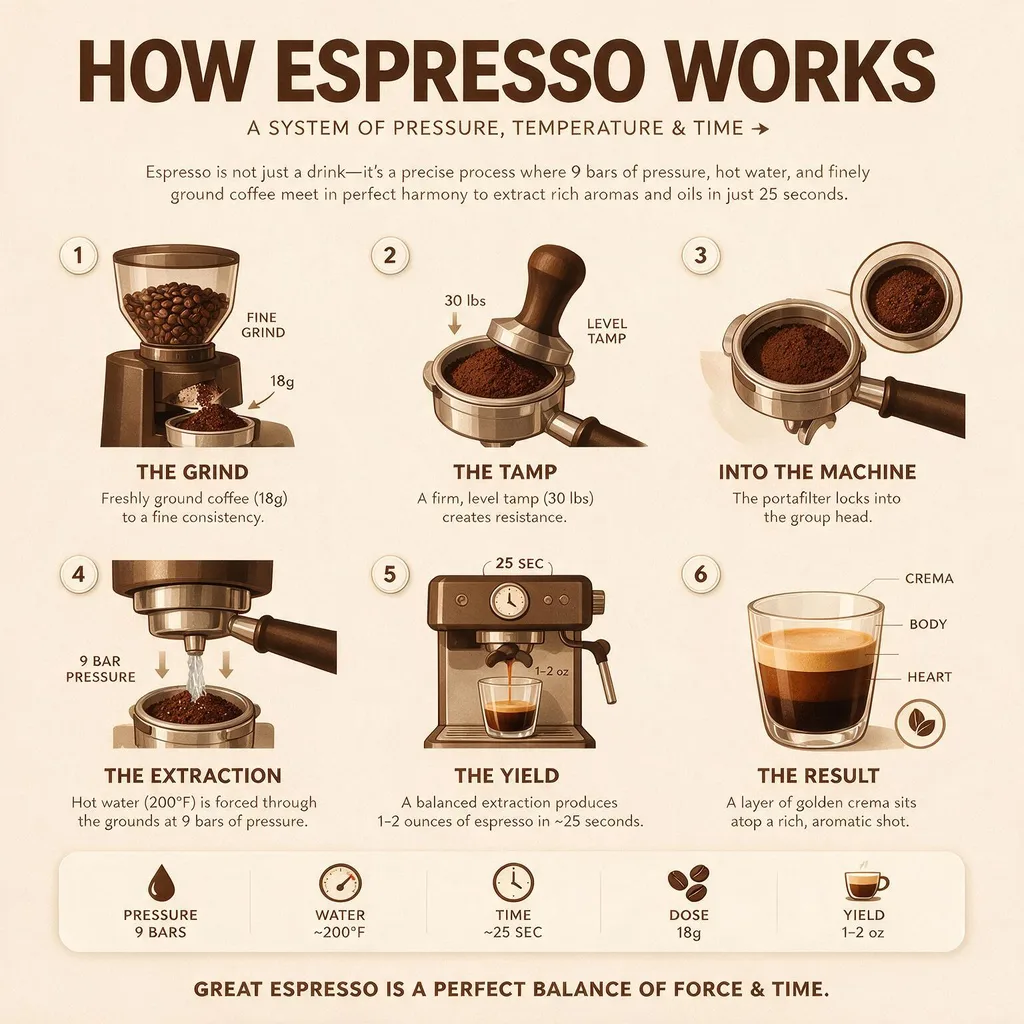
The brief here was a six-step "how espresso works" explainer. The model returned six numbered panels in reading order — grind, tamp, lock-in, extraction, yield, result — each with its own illustration and caption, plus a spec strip along the bottom (9 bars, ~200°F, ~25 sec, 18g, 1–2 oz). Every step heading is spelled correctly.
This is the "plans before it draws" behavior in practice. Older models give you something that looks like an infographic from across the room and dissolves into glyph soup when you read it. Here the hierarchy survives reading.
It's not flawless. A few lines of the small body copy go soft — legible, but you wouldn't ship them in print without a retouch pass. Headings and numbers held up everywhere.
2. Multilingual poster typography
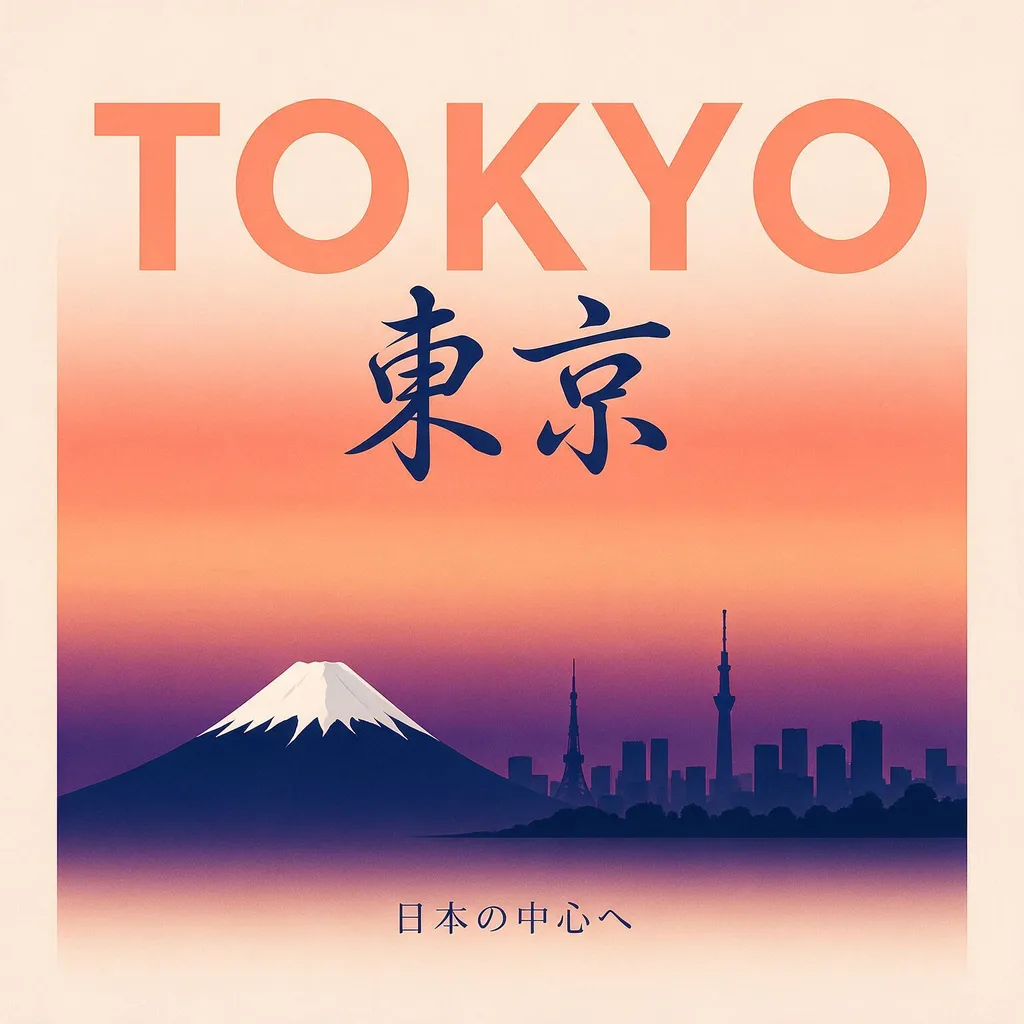
A travel poster with three layers of text in two scripts: "TOKYO" in latin display type, 東京 in brushed kanji, and a small Japanese tagline (日本の中心へ) at the bottom. All three render cleanly, at three different sizes, in a composition that still works as a poster — gradient sky, Fuji silhouette, Skytree on the horizon.
Small non-latin text at the bottom of a frame is precisely where image models used to fall apart.
3. Structured product sheets
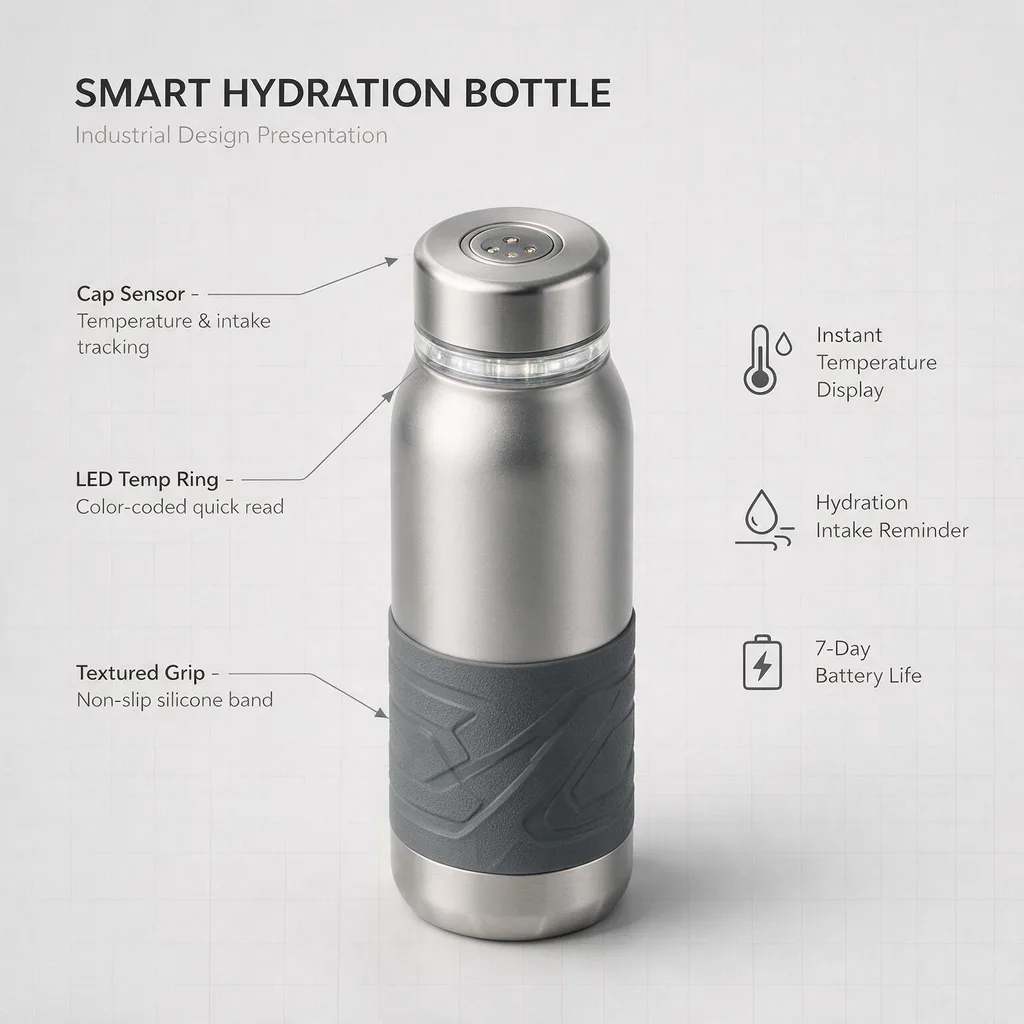
This one asked for an industrial-design presentation sheet, and the output has the full grammar of one: leader lines pointing at the cap sensor, LED ring, and grip band; a right-hand column of feature icons with labels; a title block. Every label is spelled correctly and points at the right part.
If you make ads, docs, or e-commerce listings, this category is probably the strongest practical argument for the model.
4. Photoreal portraits

A ceramic artist at the wheel, late-afternoon window light. Hands are correct (still worth saying in 2026), skin reads as skin rather than plastic, and the clay-dust texture on the apron is the kind of detail that sells a photo. Depth of field behaves like a real lens.
Good — but this is also the test where the premium is hardest to justify, which we'll get to.
Seedream 5.0 Pro vs Nano Banana 2 vs GPT Image 2: same prompt
For the comparison I gave Seedream 5.0 Pro, Nano Banana 2, and GPT Image 2 the identical prompt:
A street food stall at night in Seoul, hand-painted sign that reads "Midnight Noodles" in English and Korean, steam rising from a pot, photorealistic, cinematic lighting
It packs three hard problems into one image: bilingual sign text, atmosphere (steam, night lighting), and photorealism.
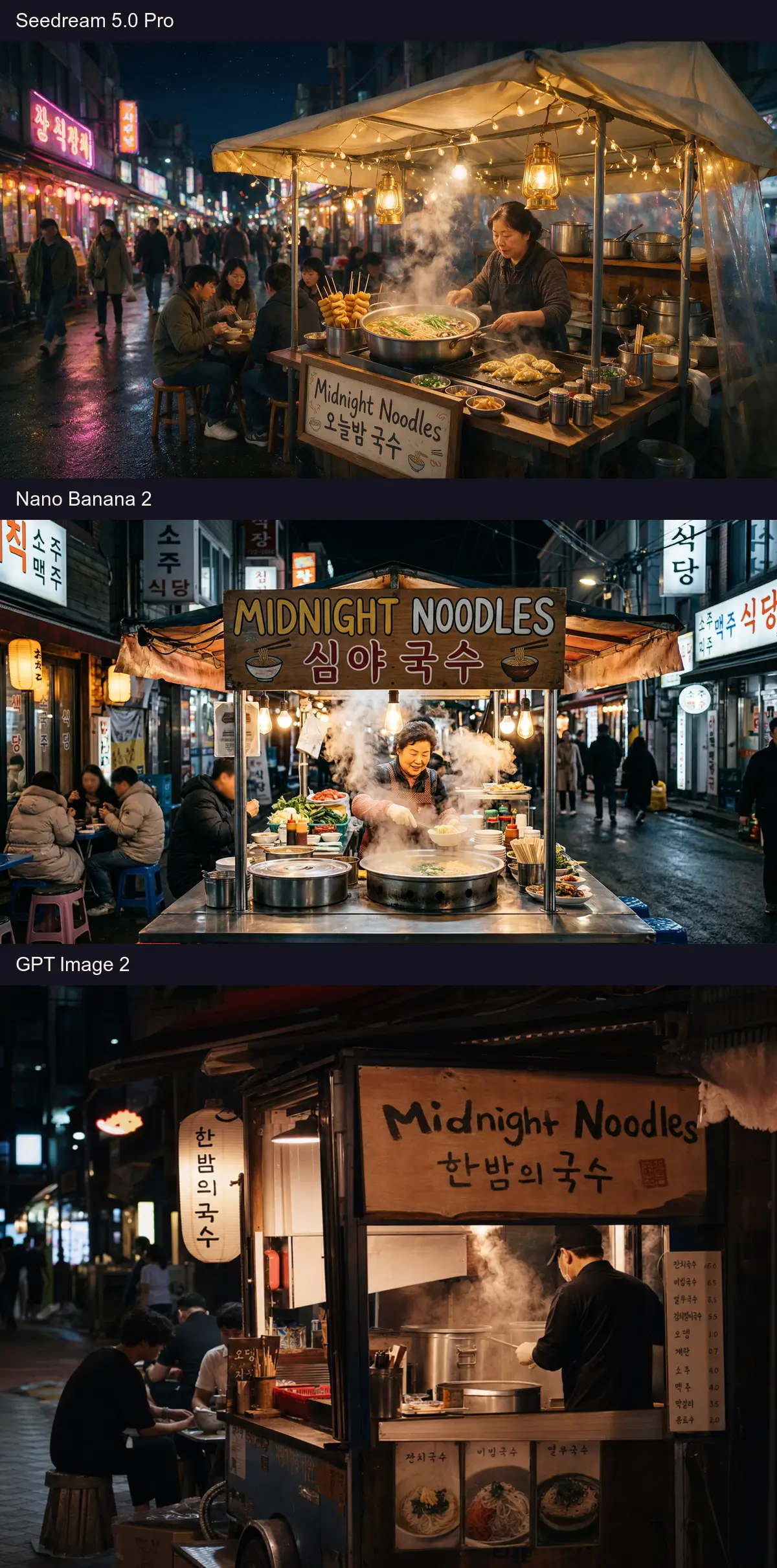
First, what all three got right: the English sign. "Midnight Noodles," hand-painted style, zero typos, on every model. That fight is over.
The Korean is where it gets interesting. The prompt didn't provide the translation, so each model had to choose one:
| Korean on the sign | Reads as | Background text | Overall feel | |
|---|---|---|---|---|
| Seedream 5.0 Pro | 오늘밤 국수 | "tonight's noodles" — close, not idiomatic | neon melts into pseudo-hangul | cinematic, art-directed, wet-street reflections |
| Nano Banana 2 | 심야 국수 | the idiomatic translation | side signs stay legible (소주, 식당) | documentary, most authentic pojangmacha |
| GPT Image 2 | 한밤의 국수 | valid, slightly literary | invented an entire priced menu board, unprompted | darkest, most camera-like |
Three observations worth pulling out:
Nano Banana 2 won the language test. 심야 국수 is what a Seoul stall would actually paint on the sign, and its background signage stays readable Korean instead of decoration. Its one oddity: it blurred two bystander faces, privacy-photo style, without being asked.
GPT Image 2 over-delivered on structure. Nobody asked for a menu, and it painted one — nine dishes with plausible names and prices, plus labeled dish photos below the counter. That instinct for inventing coherent supporting text is impressive and occasionally a liability, depending on whether you wanted it.
Seedream 5.0 Pro made the best-looking frame and the loosest translation. String lights, brass lanterns, steam curling through them, a crowd receding into neon — it's the shot a cinematographer would set up. But 오늘밤 국수 is a near-miss translation, and the background neon degrades into invented characters where Nano Banana 2 kept real words.
So the cliché ranking — "GPT for text, Nano Banana for photorealism" — doesn't fully survive contact with a real test. Text rendering is now table stakes; the differences have moved up a level, into translation judgment, background consistency, and how much unrequested structure a model volunteers.
Where it falls short
The premium needs a reason. For images with no text and no layout — portraits, food, products on plain backgrounds — Seedream 4.5 produces comparable photoreal output at roughly half the credit cost. Reach for 5.0 Pro when structure or text is doing work in the image.
Small body copy softens. Dense paragraph-size text inside infographics is readable but not print-crisp at default resolution. Plan a retouch pass or keep body copy short.
Translation is a judgment call it can lose. As the comparison shows, it renders hangul beautifully and still picked the weaker phrasing. If exact wording in a non-English language matters, put the exact wording in your prompt rather than asking the model to translate.
We haven't tested the interactive editing. The point-and-lasso region editing from ByteDance's demos lives in their own product surfaces; what the public API exposes is standard text-to-image and image-to-image. Our generator supports both, but I can't yet vouch for the demo-reel editing workflow.
How to try it yourself
You don't need an API key to reproduce any of this:
- Open the Seedream 5.0 Pro generator — the model is pre-selected there, or pick it from the dropdown on the main text-to-image generator.
- Paste one of the prompts from this review, or your own brief. Signup comes with free credits; after that, credit pricing is per-image.
- For the honest experience, judge the first take. Rerolling until it's perfect is how every model looks flawless in marketing.
If you run the Midnight Noodles prompt and get a better Korean sign than we did, the model updated — email us and we'll re-test.
References
- Introducing Seedream 5.0 Pro — ByteDance Seed — official announcement with the four headline capabilities
- GPT Image 2 vs. Nano Banana 2 — fal.ai — capability comparison of the two models we tested against
- OpenAI GPT Image 2 vs Google Nano Banana 2 — Decrypt — independent review reaching similar strengths-by-use-case conclusions
Frequently Asked Questions
Related reading
Model Reviews
Nano Banana Pro vs Nano Banana 2: Which Should You Use?
Nano Banana Pro vs Nano Banana 2 compared on 4K, speed, text and price — plus how to run Nano Banana 2 free and watermark-free, with no API key.
Guides
What Is Looksmaxing? An Honest Guide to AI Glow-Ups
What is looksmaxing, and does it actually work? An honest guide to the PSL scale, AI glow-ups, and what you can realistically change about your looks.